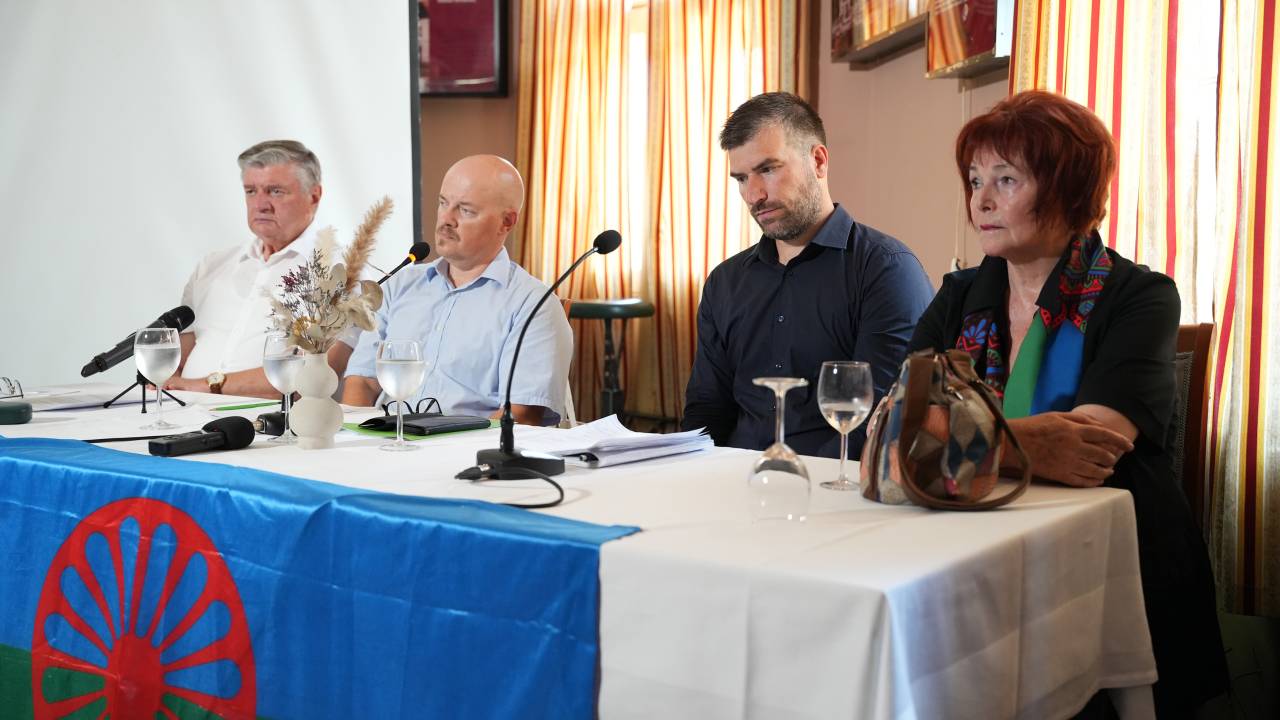
On 4 August 2026, the main commemorative ceremony marking the International Day of Remembrance for the Roma Victims of the Holocaust (Samurdaripen) took place at the Murska Republika Hall in Murska Sobota. The event, organised by the Union of Roma of Slovenia in collaboration with the Dr Šiftar Foundation, the Municipality of Murska Sobota, the Institute for Ethnic Studies, the European Roma Union, the Institute for Romani Studies in Murska Sobota and the Murska Sobota Roma Association, was dedicated to honouring the memory of the tragic events of the Second World War and reflecting on the current situation of the Roma community.
Every year, the International Day of Remembrance reminds us of the harrowing historical circumstances in which, at the Auschwitz-Birkenau extermination camp, the Nazis murdered more than 4,200 Roma and Sinti in a single wave of extermination during the night of 2 to 3 August 1944, murdered more than 4,200 Roma and Sinti in the gas chambers and burned them in the crematoria. During the Nazi persecution and extermination, around 500,000 Roma and Sinti died in Europe by 1945. The exact number will never be known, as Roma and Sinti avoided self-identification due to systematic extermination during the war and post-war discrimination. These atrocities remain a lasting reminder of the devastating consequences of hatred and racism.
Following welcoming addresses by the President of the Union of Roma of Slovenia, Jožek Horvat Muc; the Chairman of the Board of the Dr Šiftar Foundation, Marjan Šiftar; and the Deputy Mayor of the Municipality of Murska Sobota, Jure Lang, a discussion entitled ‘35 years after independence: the Roma community between the memory of genocide and the issue of social equality for Roma’, the Deputy Ombudsman, Miha Horvat, the President of the Association for the Values of the National Liberation Struggle of Slovenia, Marijan Križman, Dr Vera Klopčič, Dr Damir Josipovič and Jožek Horvat Muc. The panellists highlighted the historical significance of Samurdaripen and raised key questions regarding the (non-)realisation of social equality for Roma in contemporary Slovenian society. They agreed that, in collaboration with the Roma themselves, much more needs to be done to improve the situation of the Roma.
Photo: Sobotainfo