


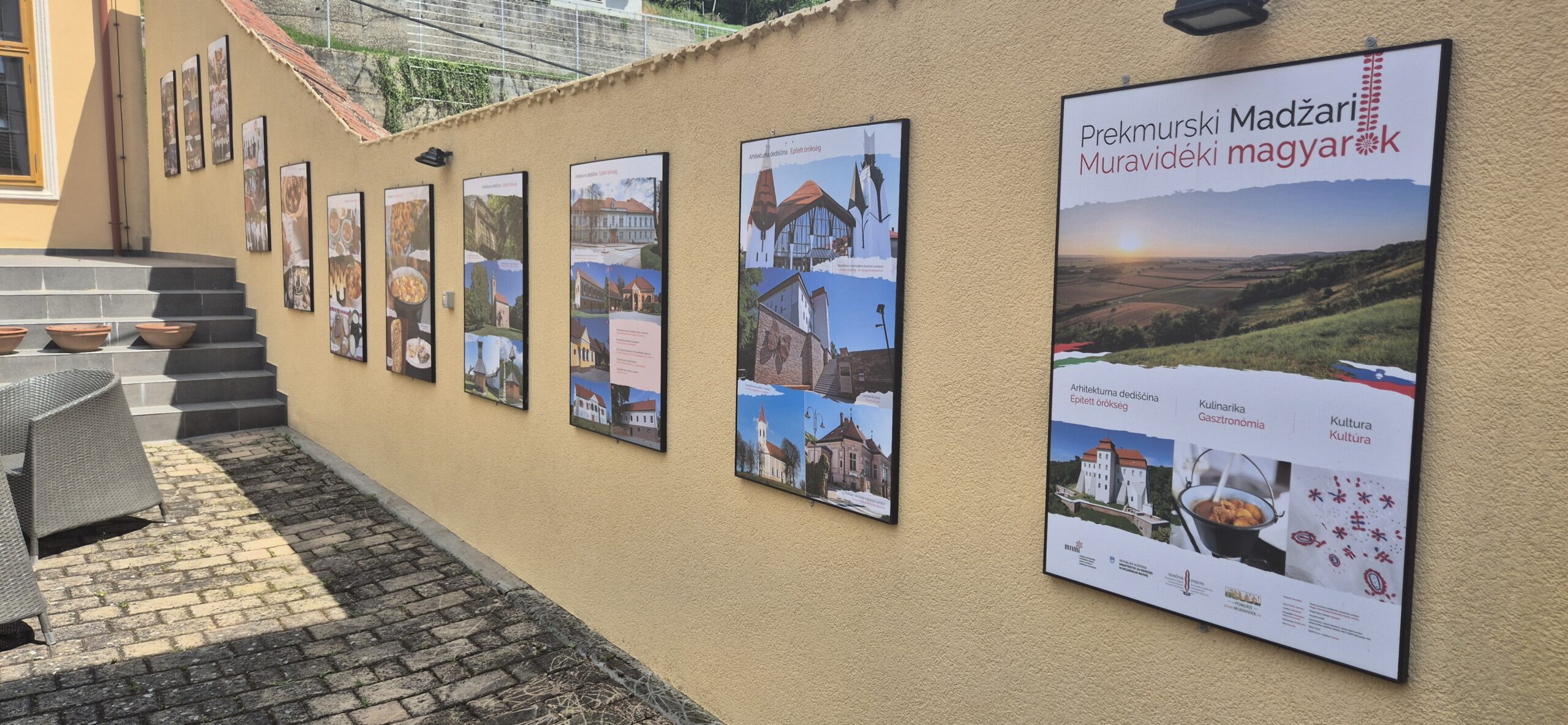
Basic information about the Hungarian national community in Slovenia
The indigenous settlement area of the Hungarian national community in Slovenia lies in the east of the country, in Prekmurje, and comprises 30 settlements along the Slovenian-Hungarian border. This is a so-called ethnically mixed area, which is administratively divided between five (bilingual) municipalities: the municipality of Lendava – Lendva, the municipality of Dobrovnik – Dobronak, the municipality of Hodoš – Hodos, the municipality of Moravske Toplice, and the municipality of Šalovci. In these five municipalities, during the last traditional census in 2002, 5,212 people declared themselves to be Hungarian according to the criterion of national affiliation, and 6,237 according to the criterion of Hungarian as their mother tongue. At the national level, the 2002 census counted 6,243 Hungarians according to the criterion of national affiliation and 7,713 Hungarians according to the criterion of mother tongue. According to our estimates, there are currently around 3,800–4,000 people living in the ethnically mixed area of Prekmurje who would identify themselves as Hungarian based on the criterion of national affiliation.
On the other hand, according to data from the State Election Commission for 2022 (at the last parliamentary elections), there were 5,485 people on the list of Hungarian voters. Taking into account the data on Hungarian voters in the local elections in autumn 2022, the majority of voters of Hungarian nationality lived in the municipality of Lendava – Lendva (around 75%), a good 10% in the municipality of Dobrovnik – Dobronak, and the remaining approximately 14% in the municipalities of Moravske Toplice (6.27%), Šalovci (3.80%) and Hodoš (3.67%).
We do not have data on the religious composition of the Hungarian population, but we estimate that 85–90% of the population in the ethnically mixed area of Prekmurje is Catholic, while the rest belong to Protestant churches (mainly Evangelical, partly Calvinist).
Legal protection of the Hungarian national community
We will present the legal protection of the Hungarian national community only through the prism of positive discrimination and will not delve into an analysis of legal regulations. The Slovenian model of protecting national communities is based on the aforementioned concept of positive discrimination, so we will briefly present those elements that meet and even exceed the standards for the protection of linguistic, ethnic, and national minorities that apply in the international community. Representatives of national communities in Slovenia actively participate in the process of creating legal norms that concern various aspects of the development of national communities. In this process, they have:
– the status of a subject, and without the consent of the legitimate representatives of the community, it is not possible to decide on the fate of the nationality;
– the right to veto all decisions of the legislator from the state to the local level;
– dual (political) subjectivity, which is reflected, among other things, in the dual voting rights of members of national communities (national parliamentary elections, local elections);
– a financial fund intended exclusively for the preservation and development of the economic foundations of national communities.
Political participation
As already mentioned, members of national communities have a “dual political personality” in the field of political participation, which means that they act as “ordinary” citizens on the one hand, and as citizens with special national rights on the other. Accordingly, Slovenian electoral law gives members of the Hungarian (and Italian) national communities the right to cast two votes in elections to the National Assembly or local authorities (municipalities): the first vote to choose a candidate in accordance with their ideological political affinity, and the second vote to elect a special representative of the national community.
– National Assembly – Article 80 of the Constitution of the Republic of Slovenia stipulates: “… one representative of the Italian and Hungarian nationalities shall be elected.” Representatives of the Hungarian (and Italian) national communities are elected by a majority voting system.
– Local self-government (municipalities or municipal councils) – Members of the Hungarian (and Italian) national communities elect at least one representative to municipal councils on the basis of the Local Self-Government Act (two representatives in the municipalities of Lendava and Moravske Toplice, and one representative in the other three bilingual municipalities).
– Self-governing national communities – Elections to self-governing national communities are regulated by the Self-Governing National Communities Act. On the basis of the aforementioned Act, members of the Hungarian national community have five self-governing national communities (one in each bilingual municipality). These five self-governing communities are then linked to the umbrella Pomurje Hungarian Self-Governing National Community.
Education and schooling
A special feature of bilingual (Slovene-Hungarian) education in the bilingual area of Prekmurje is that it is compulsory for all pupils in this area. In other words, in this ethnically mixed area, there are only bilingual schools and no monolingual Slovene or Hungarian schools. In the ethnically mixed area of Prekmurje, there will be nine bilingual kindergartens, five bilingual primary schools (one of which is for children with special needs), and one bilingual secondary school with various educational programs in the 2022/23 school year. The vertical structure of Hungarian-language education in Slovenia is complemented by the Department of Hungarian Language and Literature at the Faculty of Arts of the University of Maribor.
In the 2022/2023 school year, a total of 376 children attend bilingual kindergartens, 841 pupils attend bilingual primary schools, and 279 pupils attend bilingual secondary schools.
In kindergartens and the first three grades of bilingual primary schools, lessons are conducted according to the language-person model, which means that there are two teachers in each kindergarten class and in each of the first three grades of primary school. Both are fluent in both languages (Slovenian and Hungarian), and children can address them in either language, but the teacher/educator responds in only one language. In the first grade of bilingual elementary school, parents can choose between three literacy programs: a) Slovenian as the first language (6 hours per week) and Hungarian as the second language (3 hours per week); b) the first language is Hungarian (6 hours per week) and the second language is Slovenian (3 hours per week); c) HOP – simultaneous literacy in both languages (5 hours per week in Slovenian and Hungarian). In the upper grades of primary school (second and third triads) and in secondary school, all pupils learn Slovenian at level 1 (mother tongue) and Hungarian at level 1 or 2. In secondary school, for students coming from the monolingual/Slovene-speaking area of Prekmurje, a differentiation of Hungarian at level 2 has been prepared (in essence, they are learning Hungarian anew, i.e., level 3).
After the introduction of the Schengen regime at the borders, a precedent was set in the field of bilingual education in Prekmurje, namely the enrollment of students from Hungary in bilingual educational institutions in Prekmurje. In the 2022/23 school year, 77 pupils from Hungary are transported daily to bilingual primary schools in Prekmurje. Among the schools, the Prosenjakovci Bilingual Primary School in Goričko (in the municipality of Moravske Toplice) stands out in particular, with 33 children from neighboring settlements in Hungary attending it in the 2022/23 school year, which represents approximately 40% of all children at the school. The number of children from Hungary at other primary schools is as follows: 25 pupils (28%) at the Genterovci Bilingual Primary School and 19 out of a total of 554 pupils at the I Lendava Bilingual Primary School.
Hungarian ethnic media and information
The Hungarian national community in Slovenia has three media outlets that provide information to its members in their native language. The weekly newspaper Népújság, which is part of the Hungarian Nationality Information Agency, has been published since 1958. In addition to the newspaper, RTV Slovenia also operates Pomurski madžarski radio (PMR-MMR) and TV studio Lendava. Pomurski madžarski radio (Muravidéki Magyar Rádió) broadcasts 24 hours a day, with live programming from 5:30 a.m. to 7:00 p.m. TV Studio Lendava (better known as Mostovi – Hidak) produces four half-hour programs per week, which are broadcast from Tuesday to Friday – premiering at 3:10 p.m. on Channel 1 of Televizija Slovenija, with reruns on Channel 3. Both PMR and TV Studio Lendava programs are also available on the website www.rtvslo.si, while the Népújság newspaper is available on the website https://nepujsag.net/.
Cultural life
The Hungarian Cultural Institute (ZKMN-MNMI) is responsible for promoting Hungarian culture in Slovenia. Under its auspices, the Bánffy Center operates, which houses a Hungarian bookstore and café. ZKMN was among those institutions of the Hungarian national community in Slovenia that faced the greatest difficulties due to the COVID-19 epidemic, as cultural life came to a standstill in all areas, especially in the context of amateur activities, where the constant work of associations and cultural sections was interrupted. Nevertheless, there are currently 29 associations operating in the ethnically mixed area, which (also) carry out Hungarian national programmes and activities.
Economic and social situation of the national community
The financial situation and social composition of the Hungarian national community do not differ significantly from the average situation in the region (Pomurska region), but it should be noted that the Pomurska region is the least developed region in Slovenia and that the ethnically mixed area in Prekmurje, especially the Goričko part of this area, is among the most demographically and economically vulnerable areas in the country.
Since 2016, the state budget has included annual non-repayable financial incentives for the creation of an economic base for indigenous national communities for the development of the economic base of the area where members of the Hungarian (and Italian) indigenous national communities live. These financial incentives are allocated in the state budget on the basis of the Program for the Promotion of the Economic Base of the Hungarian National Community. The first program was implemented in the period 2017–2020, and the second program, which runs from 2021 to 2024, is currently being implemented. In the first program period, investments in the economy and in tourism activities and products were promoted, while in the period 2021 –2024, the program is aimed at developing the economic base of the area where members of the Hungarian indigenous national community live, which in more detail means creating new jobs and preserving existing ones, establishing new infrastructure and modernizing existing infrastructure, and increasing the attractiveness of the area.
Available content

